Today's training tip begins with Ground Work. It is vitally important, and yet sadly it is also very overlooked. The busy rider just doesn't have the time to spend with their horse, especially if they board, doing anything but riding. I hope after reading this, you will feel differently about that, even if that means instead of going riding one day, you do some ground work instead.
This training tip also applies to those who say, "But my horse is well behaved, he doesn't need training on the ground." I have three things to say to that remark. 1. You are lucky that nothing has fallen apart yet, but don't be surprised if it does. 2. Ground work is not just about the training of the horse. It is training for you too. Realize that we are always teaching our horse, every time we are around him. 3. Doing the kind of ground work I'm going to discuss can not only be considered training, but it WILL enhance your relationship, increase the horse's respect for you, and make you all around better partners.
If you are not familiar with how to use our body language with the horse, please read this article now which touches on the basics. However, there are even more very subtle signals that we are
sending our equine friends.
Horses being prey animals view life in a way that helps ensure their very lives. A predator attacking will typically go for the neck/head. This is why looking directly at the horse, with our two eyes in front, is threatening. Take this a step further, and notice how you stand. Your center is your belly. If your center is directed toward his head, he will likely toss his head up in response to your 'rudeness.' You can bend or turn slightly and his reaction will be more relaxed.
I find that when there seems to be a behavior problem with the horse, it can usually be traced back to the way he is handled. And many times it is something so subtle, the owner has no idea what is going on. The horse is actually REacting to signals you sent. He is not misbehaving, he is acting like a horse. He is reading you like he reads his herd. He has no other way. We, however, do. We can learn the best way to 'talk' to them, since they can not learn our verbal language, nor do they have the ability to think or act like a predator.
Think about what you've just read the next time you greet your horse. If you go right up to him, look at him and kiss, or hug him, don't be surprised if that head goes flying up. (By the way, horses don't really 'get' kissing and hugging. They'd rather have a good scratch on the withers or have you blow in their nostril.)
I will continue writing about this topic, there is a lot to cover!
If you are in Fairfax County, VA, I am now teaching people how to have a better relationship with their horses using these techniques.
Loretta
The Horse Speaks

Clear Communication/Visible Results
Showing posts with label communicate. Show all posts
Showing posts with label communicate. Show all posts
Wednesday, May 20, 2009


Training Tip G-Ground Work
Today's training tip begins with Ground Work. It is vitally important, and yet sadly it is also very overlooked. The busy rider just doesn't have the time to spend with their horse, especially if they board, doing anything but riding. I hope after reading this, you will feel differently about that, even if that means instead of going riding one day, you do some ground work instead.
This training tip also applies to those who say, "But my horse is well behaved, he doesn't need training on the ground." I have three things to say to that remark. 1. You are lucky that nothing has fallen apart yet, but don't be surprised if it does. 2. Ground work is not just about the training of the horse. It is training for you too. Realize that we are always teaching our horse, every time we are around him. 3. Doing the kind of ground work I'm going to discuss can not only be considered training, but it WILL enhance your relationship, increase the horse's respect for you, and make you all around better partners.
If you are not familiar with how to use our body language with the horse, please read this article now which touches on the basics. However, there are even more very subtle signals that we are
sending our equine friends.
Horses being prey animals view life in a way that helps ensure their very lives. A predator attacking will typically go for the neck/head. This is why looking directly at the horse, with our two eyes in front, is threatening. Take this a step further, and notice how you stand. Your center is your belly. If your center is directed toward his head, he will likely toss his head up in response to your 'rudeness.' You can bend or turn slightly and his reaction will be more relaxed.
I find that when there seems to be a behavior problem with the horse, it can usually be traced back to the way he is handled. And many times it is something so subtle, the owner has no idea what is going on. The horse is actually REacting to signals you sent. He is not misbehaving, he is acting like a horse. He is reading you like he reads his herd. He has no other way. We, however, do. We can learn the best way to 'talk' to them, since they can not learn our verbal language, nor do they have the ability to think or act like a predator.
Think about what you've just read the next time you greet your horse. If you go right up to him, look at him and kiss, or hug him, don't be surprised if that head goes flying up. (By the way, horses don't really 'get' kissing and hugging. They'd rather have a good scratch on the withers or have you blow in their nostril.)
I will continue writing about this topic, there is a lot to cover!
If you are in Fairfax County, VA, I am now teaching people how to have a better relationship with their horses using these techniques.
Loretta
The Horse Speaks
This training tip also applies to those who say, "But my horse is well behaved, he doesn't need training on the ground." I have three things to say to that remark. 1. You are lucky that nothing has fallen apart yet, but don't be surprised if it does. 2. Ground work is not just about the training of the horse. It is training for you too. Realize that we are always teaching our horse, every time we are around him. 3. Doing the kind of ground work I'm going to discuss can not only be considered training, but it WILL enhance your relationship, increase the horse's respect for you, and make you all around better partners.
If you are not familiar with how to use our body language with the horse, please read this article now which touches on the basics. However, there are even more very subtle signals that we are
sending our equine friends.
Horses being prey animals view life in a way that helps ensure their very lives. A predator attacking will typically go for the neck/head. This is why looking directly at the horse, with our two eyes in front, is threatening. Take this a step further, and notice how you stand. Your center is your belly. If your center is directed toward his head, he will likely toss his head up in response to your 'rudeness.' You can bend or turn slightly and his reaction will be more relaxed.
I find that when there seems to be a behavior problem with the horse, it can usually be traced back to the way he is handled. And many times it is something so subtle, the owner has no idea what is going on. The horse is actually REacting to signals you sent. He is not misbehaving, he is acting like a horse. He is reading you like he reads his herd. He has no other way. We, however, do. We can learn the best way to 'talk' to them, since they can not learn our verbal language, nor do they have the ability to think or act like a predator.
Think about what you've just read the next time you greet your horse. If you go right up to him, look at him and kiss, or hug him, don't be surprised if that head goes flying up. (By the way, horses don't really 'get' kissing and hugging. They'd rather have a good scratch on the withers or have you blow in their nostril.)
I will continue writing about this topic, there is a lot to cover!
If you are in Fairfax County, VA, I am now teaching people how to have a better relationship with their horses using these techniques.
Loretta
The Horse Speaks
Sunday, March 8, 2009
Piero's Training Day 4
Wow. I am so excited! I worked with Piero yesterday, and he was super! He is really catching on to the ground work and understanding that I am the herd leader-all the time!
So, yesterday after a short round of ground work, I groomed him and tacked him up. We did a little more ground work, sending back, halting and following, then I got on him. Wow. I was so surprised. When I went to visit him before he came to live with me, I was told that when he was under saddle he was very full of it. They couldn't touch him behind the leg or on his rump. And had to ride with their legs away from his side because of his sensitivity. I knew I felt from the beginning that he was misunderstood, and I guess I was right on there. He was perfect under saddle. It's been two weeks since he arrived and I've not asked much of him except for the little bits of ground work that we've been doing.
He was calm, quite, just wonderful. I had my legs flapping all around him, and took my feet out of the stirrups, put them back in, and he was fine. I turned around and patted his rump, no problem. We trotted and I got an immediate halt when I asked. All this with very light contact. I almost felt like he was saying thank you and that he was very greatful that I took this approach.
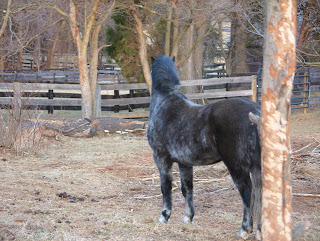
I am confident that he will have no further issues and will be quite easy to sell. He has been to shows at Upperville and Frying Pan!
My theory on Piero's previous misbehavior: When the owner let her friend borrow him, they started using him within a couple of days for lessons. I believe that he did not have a human herd leader, and that was the main problem. Do all horses need that in order to behave properly? No. Not all do. However, some do. And maybe that's a good thing. Maybe those are the ones that still have theior original horse spirit in them. They are, after all, herd animals that look for leadership. I read an article written by the dog whisperer and he said that dogs need 1. discipline/direction 2. exercise 3. affection IN THAT ORDER.
I believe it is the same for equines. We want to be loving and doting on them, but that is not really what they are looking for. These things are human desires that we put onto our equine friends. Now that we know better, we can not only better communicate, but better coexist with one another.
More on that thought tomorrow!
clear communication
visible results
So, yesterday after a short round of ground work, I groomed him and tacked him up. We did a little more ground work, sending back, halting and following, then I got on him. Wow. I was so surprised. When I went to visit him before he came to live with me, I was told that when he was under saddle he was very full of it. They couldn't touch him behind the leg or on his rump. And had to ride with their legs away from his side because of his sensitivity. I knew I felt from the beginning that he was misunderstood, and I guess I was right on there. He was perfect under saddle. It's been two weeks since he arrived and I've not asked much of him except for the little bits of ground work that we've been doing.
He was calm, quite, just wonderful. I had my legs flapping all around him, and took my feet out of the stirrups, put them back in, and he was fine. I turned around and patted his rump, no problem. We trotted and I got an immediate halt when I asked. All this with very light contact. I almost felt like he was saying thank you and that he was very greatful that I took this approach.

I am confident that he will have no further issues and will be quite easy to sell. He has been to shows at Upperville and Frying Pan!
My theory on Piero's previous misbehavior: When the owner let her friend borrow him, they started using him within a couple of days for lessons. I believe that he did not have a human herd leader, and that was the main problem. Do all horses need that in order to behave properly? No. Not all do. However, some do. And maybe that's a good thing. Maybe those are the ones that still have theior original horse spirit in them. They are, after all, herd animals that look for leadership. I read an article written by the dog whisperer and he said that dogs need 1. discipline/direction 2. exercise 3. affection IN THAT ORDER.
I believe it is the same for equines. We want to be loving and doting on them, but that is not really what they are looking for. These things are human desires that we put onto our equine friends. Now that we know better, we can not only better communicate, but better coexist with one another.
More on that thought tomorrow!
clear communication
visible results
Piero's Training Day 4
Wow. I am so excited! I worked with Piero yesterday, and he was super! He is really catching on to the ground work and understanding that I am the herd leader-all the time!
So, yesterday after a short round of ground work, I groomed him and tacked him up. We did a little more ground work, sending back, halting and following, then I got on him. Wow. I was so surprised. When I went to visit him before he came to live with me, I was told that when he was under saddle he was very full of it. They couldn't touch him behind the leg or on his rump. And had to ride with their legs away from his side because of his sensitivity. I knew I felt from the beginning that he was misunderstood, and I guess I was right on there. He was perfect under saddle. It's been two weeks since he arrived and I've not asked much of him except for the little bits of ground work that we've been doing.
He was calm, quite, just wonderful. I had my legs flapping all around him, and took my feet out of the stirrups, put them back in, and he was fine. I turned around and patted his rump, no problem. We trotted and I got an immediate halt when I asked. All this with very light contact. I almost felt like he was saying thank you and that he was very greatful that I took this approach.
I am confident that he will have no further issues and will be quite easy to sell. He has been to shows at Upperville and Frying Pan!
My theory on Piero's previous misbehavior: When the owner let her friend borrow him, they started using him within a couple of days for lessons. I believe that he did not have a human herd leader, and that was the main problem. Do all horses need that in order to behave properly? No. Not all do. However, some do. And maybe that's a good thing. Maybe those are the ones that still have theior original horse spirit in them. They are, after all, herd animals that look for leadership. I read an article written by the dog whisperer and he said that dogs need 1. discipline/direction 2. exercise 3. affection IN THAT ORDER.
I believe it is the same for equines. We want to be loving and doting on them, but that is not really what they are looking for. These things are human desires that we put onto our equine friends. Now that we know better, we can not only better communicate, but better coexist with one another.
More on that thought tomorrow!
clear communication
visible results
So, yesterday after a short round of ground work, I groomed him and tacked him up. We did a little more ground work, sending back, halting and following, then I got on him. Wow. I was so surprised. When I went to visit him before he came to live with me, I was told that when he was under saddle he was very full of it. They couldn't touch him behind the leg or on his rump. And had to ride with their legs away from his side because of his sensitivity. I knew I felt from the beginning that he was misunderstood, and I guess I was right on there. He was perfect under saddle. It's been two weeks since he arrived and I've not asked much of him except for the little bits of ground work that we've been doing.
He was calm, quite, just wonderful. I had my legs flapping all around him, and took my feet out of the stirrups, put them back in, and he was fine. I turned around and patted his rump, no problem. We trotted and I got an immediate halt when I asked. All this with very light contact. I almost felt like he was saying thank you and that he was very greatful that I took this approach.
I am confident that he will have no further issues and will be quite easy to sell. He has been to shows at Upperville and Frying Pan!
My theory on Piero's previous misbehavior: When the owner let her friend borrow him, they started using him within a couple of days for lessons. I believe that he did not have a human herd leader, and that was the main problem. Do all horses need that in order to behave properly? No. Not all do. However, some do. And maybe that's a good thing. Maybe those are the ones that still have theior original horse spirit in them. They are, after all, herd animals that look for leadership. I read an article written by the dog whisperer and he said that dogs need 1. discipline/direction 2. exercise 3. affection IN THAT ORDER.
I believe it is the same for equines. We want to be loving and doting on them, but that is not really what they are looking for. These things are human desires that we put onto our equine friends. Now that we know better, we can not only better communicate, but better coexist with one another.
More on that thought tomorrow!
clear communication
visible results
Sunday, February 8, 2009
A-Z Training Tips C=Communicate

Today's tip: Communicate
We are constantly communicating with our horse. We catch him, groom him, tack him up and go riding. When is the communicating going on? The ENTIRE time. And guess what? When you aren't preparing for a ride you are still communicating with the horse.
You go out to feed, to clean stalls, etc....Every time you come into contact with him, you are communicating with him. Try to take the time and notice what you are saying. This includes verbally, with your thoughts and intentions and physically. Horses are sensitive, they can feel your thoughts and emotions. They stay alive by reading body language, so really pay attention to how you use your body. When you are cleaning the barn and your horse is in the way, do you automatically walk around him? The one who directs the horses feet and gets them moving is the leader.So, if you are moving around him, then in his mind, he out ranks you in his herd.
You DO NOT want that!
It is very important that you are able to have your horse move front,back,left and right without moving your feet. The more this is practiced, the more respect he will have for you. Do you ever watch horses together in a field? The leader of my herd of 3 will often move the others for what seems like no apparent reason. So, sometimes I will go out and move him, just because I can. This really keeps him sharp, and in check. You might be saying to yourself, "But my horse does not seem disrespectful." That may be. Some horses are conditioned in a way that these things do not SEEM to affect their behavior. Usually, over time, something will come up, and the issue can be traced back to lack of respect due to improper body language. For more on body language, see my post for tip B.
If you are located in Northern VA, I am conducting a demonstration using some of these techniques. Visit http://www.meetup.com/trailriders/
A-Z Training Tips C=Communicate
Today's tip: Communicate
We are constantly communicating with our horse. We catch him, groom him, tack him up and go riding. When is the communicating going on? The ENTIRE time. And guess what? When you aren't preparing for a ride you are still communicating with the horse.
You go out to feed, to clean stalls, etc....Every time you come into contact with him, you are communicating with him. Try to take the time and notice what you are saying. This includes verbally, with your thoughts and intentions and physically. Horses are sensitive, they can feel your thoughts and emotions. They stay alive by reading body language, so really pay attention to how you use your body. When you are cleaning the barn and your horse is in the way, do you automatically walk around him? The one who directs the horses feet and gets them moving is the leader.So, if you are moving around him, then in his mind, he out ranks you in his herd.
You DO NOT want that!
It is very important that you are able to have your horse move front,back,left and right without moving your feet. The more this is practiced, the more respect he will have for you. Do you ever watch horses together in a field? The leader of my herd of 3 will often move the others for what seems like no apparent reason. So, sometimes I will go out and move him, just because I can. This really keeps him sharp, and in check. You might be saying to yourself, "But my horse does not seem disrespectful." That may be. Some horses are conditioned in a way that these things do not SEEM to affect their behavior. Usually, over time, something will come up, and the issue can be traced back to lack of respect due to improper body language. For more on body language, see my post for tip B.
If you are located in Northern VA, I am conducting a demonstration using some of these techniques. Visit http://www.meetup.com/trailriders/
Subscribe to:
Posts (Atom)